
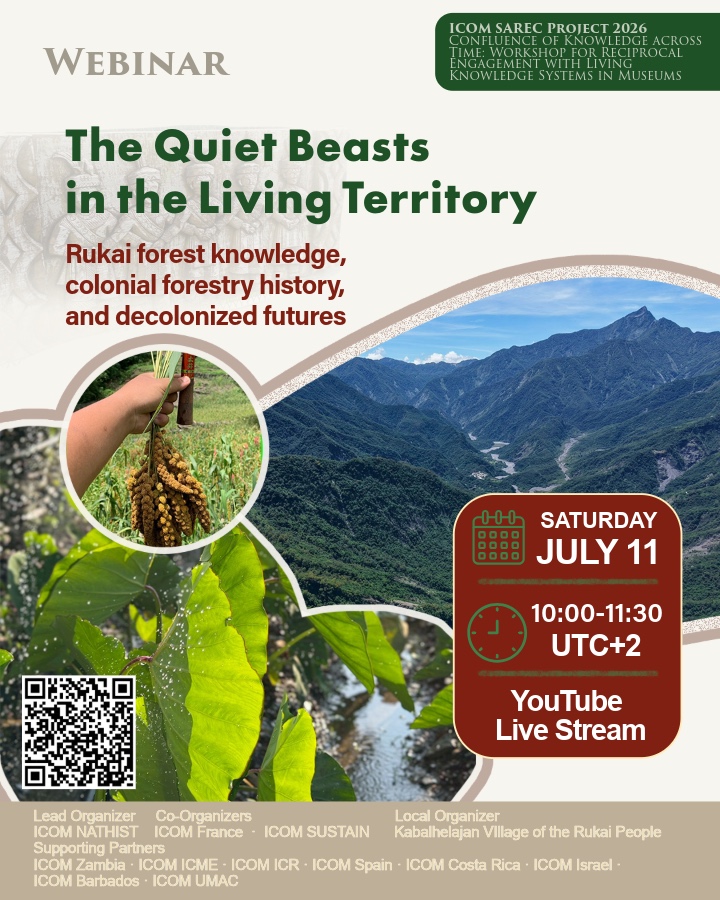
Date: Saturday, 11 July 2026
Time: 10:00–11:30 AM UTC+2 / 16:00–17:30 UTC+8
Format: Online — YouTube Livestream at https://www.youtube.com/@ICOMNatHist
Registration: https://forms.gle/76GTK9bUkam3hbuQ6
When museums begin to take knowledge systems seriously beyond Western modern epistemology, such as traditional ecological knowledge and diverse local knowledge, interpreting these plural systems often falls into a stereotype or template. More importantly, the frontline interpretive work that directly shapes audience experience, especially the guided tours, remains bound by the perspectival limits of Western modern knowledge and contemporary social frameworks. For museums, genuinely accommodating local knowledge systems within the field of interpretation is not easy, because the information museums receive is itself already fragmented: modern social frameworks differ vastly from the contexts traditional knowledge originally grew from, generational gaps in proficiency of native languages, which is the very carriers of knowledge, are too wide, and the environments that local communities inhabit shift across time and space due to policy change, demographic, and climate factors. When these fractures compound with the rise of village tourism or the involvement of local administrative bureaucracy, cultural interpretation comes under continuous external influence, making the interpretation and transmission of local traditional knowledge harder still.
This forum brings together elders who lived through the era of forestry plantation policy, sharing traditional knowledge of trees — from the traditional forest landscape to how colonial forestry policy transformed the mountains — and how today’s youth are learning to read this history anew and search for decolonial pathways. It also brings a female elder sharing traditional farming knowledge in conversation with a young woman learning the native names of traditional plants, presenting through different themes and gendered perspectives the real shape of how knowledge is passed down and broken across generations. Through the actions of Kabalelradhane Village (神山部落) Rukai people, we hope to connect elders who continue to practice traditional knowledge in daily life with the middle and younger generation, determined to repair these fractures and reclaim the authority of cultural interpretation — together exploring what it might mean for museums, cultural interpretation, and traditional knowledge to genuinely coexist.
Program (UTC+2)
10:00–10:10 | Opening Remarks and Group Photo
10:10–10:20 | Introduction: The topic and the “Cultural Learning Week”
10:20–10:35 | Interview I: Forest Knowledge and Colonial History
10:35–10:50 | Interview II: Farming Knowledge and Intergenerational Dialogue
10:50–11:00 | Commentary from SAREC Project partners
11:00–11:25 | Q&A and Open Discussion
11:25–11:30 | Closing Remarks
Organizers
Lead Organizer: ICOM NATHIST
Co-organizers: ICOM France · ICOM SUSTAIN
Supporting Partners: ICOM Zambia · ICOM ICME · ICOM ICR · ICOM Spain · ICOM Costa Rica · ICOM Israel · ICOM Barbados · ICOM UMAC
Local Partner: 1ᴺ Studio · Kabalelradhane Village of the Rukai people