
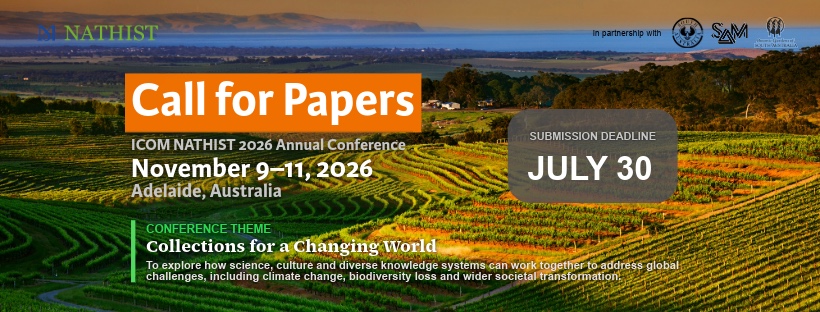
November 9–11, 2026 | Adelaide, Australia
Theme: Collections for a Changing World
To explore how science, culture and diverse knowledge systems can work together to address global challenges, including climate change, biodiversity loss and wider societal transformation.
Natural history collections — including preserved animals and plants, fossil material, geological evidence of change and even living collections — represent centuries of irreplaceable biodiversity documentation. As the world faces accelerating climate change, biodiversity loss, and diverse ecological pressures, these collections are emerging as critical research infrastructure that can inform decision making. Sharing the outcomes from research across our globally diverse cultures and knowledge systems can better inform the role natural history collections play. Adapting to climate fluctuations, social and political change and the ongoing challenge of protecting our collections under a range of financial and physical disruptions at a time, their value and uses are increasing. Please share your research and practice-based insights on how collections can be mobilised, interpreted, and expanded to meet present and future challenges.
Submission Themes
Please nominate your 1st and 2nd preferences among the following options:
- Exploring what is a natural history collection: 2026 and beyond.
- Disaster preparedness – thinking about the unthinkable.
- Urban greening and biodiversity protection.
- Sustainability and collections conservation in a changing world.
- Exemplars of global collaboration in natural history collections use.
- The importance of living collections as natural history collections.
- Collections data and its central role in monitoring environmental change.
- General theme.
Submission Guidelines
- Language: English.
- Formats: Oral Presentation (15 min) or Lightning Talk (5 min).
- Limits: Title ( 50 words), Abstract (250 words), Keywords (2–5).
- Methods: Please refer to the online registration portal https://icom-nathist2026.eventsairsite.com/
- Author information: Presenting Author, Co-Authors and Affiliations are to be entered online through the portal the conference organiser provides. Each author will have the option to submit a 50-word work biographical note.
Important Dates (2026)
- Call for Abstracts Opens: May 31st.
- Submissions Close:
First round- June 30th; Second round July 30th. - Notification of Acceptance: Mid-August.
For any questions, please refer to the official website (to be online by mid June); before mid June, please email ICOM NATHIST Secretary at secretary.nathist@icom.museum
Policy on the Use of Artificial Intelligence
ICOM NATHIST acknowledges that artificial intelligence (AI) tools are increasingly used in the everyday work of museum professionals. In the interest of transparency and academic integrity, the following policy applies to all abstract and paper submissions to the 2026 Annual Conference.
Permitted Use
The utilization of AI tools are limited to the enhancement of clarity and linguistic quality, including basic spell-checking, grammar checking, language editing and formatting assistance; translation support for non-native English speakers; and statistical analysis and generating graphs/schematics from the research results.
Disclosure Requirement
If there’s any use of AI in the preparation of a submission, beyond improving readability and language, authors are required to include a brief disclosure statement in an accompanying note after the abstract. For example:
“AI Usage Disclosure: The abstract was created with assistance in statistical analysis from ChatGPT / Gemini / [tool name] . The content has been reviewed and edited by a human.”
Not Permitted
- Major academic publishers are prohibiting the attribution of authorship to AI tools. The organising committee therefore decides that AI cannot be listed as one of the authors.
- Using generative AI to prepare text without disclosure, is considered a form of academic dishonesty.
- Create content with AI tools that the author(s) has not verified in person.
Responsibility
Whether or not using AI tools, authors should hold the full responsibility for the accuracy, originality, authenticity, and integrity of all submitted content. The organising committee reserves the right to withdraw any accepted abstracts that are found to be violating the policy.